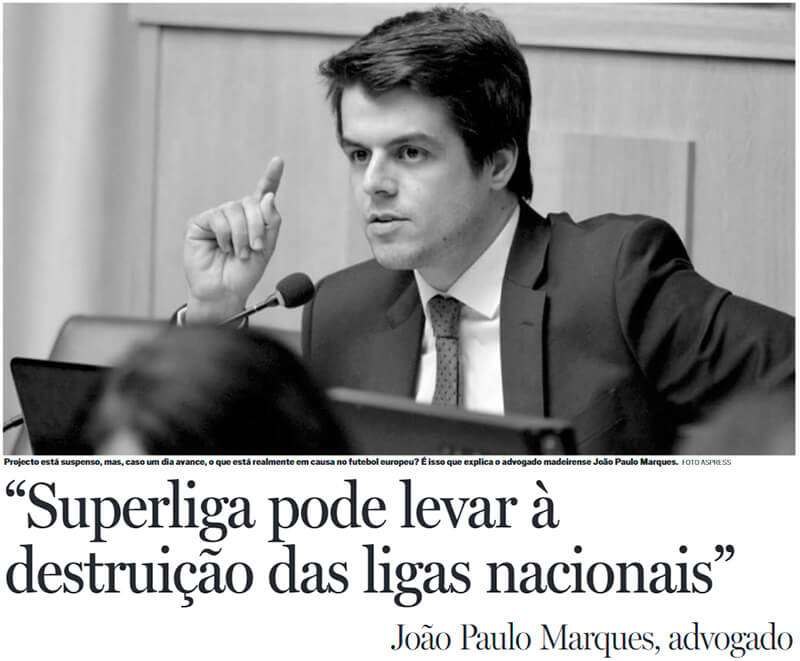
Lawyer João Paulo Marques spoke to the Madeira Daily News about the recent case of the European Super League and the impact it would have on national football.
In an interview with the Madeiran morning newspaper, the lawyer stated that "If the Super League is confirmed, it would be the 'Americanization' of European football.".
Read the full interview below:
Does this Super League go against the European Union's standards regarding the openness and fairness of competitions?
According to European rules, economic agents are prohibited from making agreements that lead to a reduction in competition. This means that clubs cannot join together in a competition in order to...
This reduces opportunities for competition not only for other clubs, but also for fans as consumers of football.
This means that the problem is not the creation of an alternative league, but the fact that this competition is closed, that is, in which there are clubs with guaranteed participation, regardless of their sporting merit, and the entry of new clubs is severely hampered.
If the Super League hypothesis is confirmed, it would be an "Americanization" of European football, as it would reproduce a closed competition model like the one currently practiced in basketball (NBA) or football (MLS).
Do FIFA and UEFA have the legal power to prevent players currently in the Super League from representing their national teams?
This is a complex issue. If we look only at the regulations of the two organizations, UEFA and FIFA have the legal framework to apply sanctions not only to players, but also to clubs participating in the Super League. But does UEFA want to organize a European Championship in which the best European players will not be present?
On the other hand, clubs feel comfortable with a decision taken by the General Court of the European Union in December 2020, which upheld a sanction imposed by the Directorate-General for Competition on the International Skating Union for preventing athletes from competing for their national teams.,
simply because they had participated in competitions not authorized by that federative body.
Can Superliga players be prevented from transferring to clubs outside of that competition?
A curious question, because the answer demonstrates how we are facing new and dangerous territory for football. As for the players, it wouldn't be the first time an athlete has been banned from competition for violating regulations. Moreover, the clubs themselves would also be subject to a ban on participating in the transfer market for a certain period.
But there is another perspective on the problem. Clubs participating in the Super League that, through this participation, create disciplinary problems for their athletes, or prevent them from representing their country, may be placing themselves in a situation of breach of contract with these players. We could be facing a widespread scenario of players terminating their employment contracts, alleging just cause.
Do you believe that the clubs still present in this year's Champions League (Real Madrid, Chelsea and Manchester City) will be banned from the competition, and that FC Porto could even benefit from a possible 'relegation play-off'?
It seems highly unlikely to me that this will happen. It's not the first time there's been talk of a European Super League, and this possibility usually coincides with the eve of the new sporting and financial model for the Champions League. Therefore, we may be witnessing only a strategic move by the biggest clubs in an attempt to increase their share of the revenue distributed by UEFA and FIFA.
What sanctions could be imposed on these clubs within the domestic leagues?
Most national leagues have this possibility defined in their regulations. The Premier League itself, the league from which six of the founding clubs of the Super League come, has already warned that it will not authorize the participation of [clubs].
English clubs in the European Super League, meaning we could end up with an English League without its biggest clubs!
Perhaps that's why some clubs, especially English ones, have already backed away from creating and participating in a competition parallel to the Champions League. I have no doubt that the possibility of being expelled from the Premier League and, consequently, the enormous loss of revenue, were key factors in this decision by the clubs.
The Euroleague basketball league set a precedent back in 2000. Does the Super League football league have the arguments to follow the same path?
The legal issue that pitted the Euroleague against FIBA (International Basketball Federation) is, in fact, very similar to the problem that exists today in the world of football – the abuse of a dominant position.
UEFA and FIFA may be abusing their dominant position, which was, in fact, the decision of the European Court regarding the International Skating Union; that is, they are regulators of the activity and at the same time...
Economic operators, as they organize and exploit competition in the markets they regulate.
The problem lies not in the dominant position itself, but in its abuse, such as using it to prevent players from representing their national teams. The Superliga clubs, anticipating this possibility, have already initiated legal proceedings, most likely with the aim of reaching the Court of Justice of the European Union, because this will effectively be a landmark issue for football and for European competition law.
What consequences would a European Super League have for smaller leagues, such as the Portuguese league?
I believe the effects could be devastating. The creation of the Super League could lead to the destruction of national leagues, especially smaller ones like the Portuguese league.
This is clearly a fight for television broadcasting money, and it's obvious that by emptying the Champions League by creating an alternative competition, the clubs are effectively devaluing it. And if they then concentrate on a closed competition, where access for smaller clubs is severely limited, it's clear that this constitutes an unprecedented attack on the sustainability of football.
The appeal of football lies not only in the big clubs, but in the competition that exists between them all. When that competitive environment ceases to exist, football loses its appeal. And if it loses appeal, it ceases to have economic value. The big clubs need to understand this.
-

- Interview – Part 1

-
- Interview – Part 2